Effect of Digital Media and Screens on Children: A Parent Guide from Happy Circle
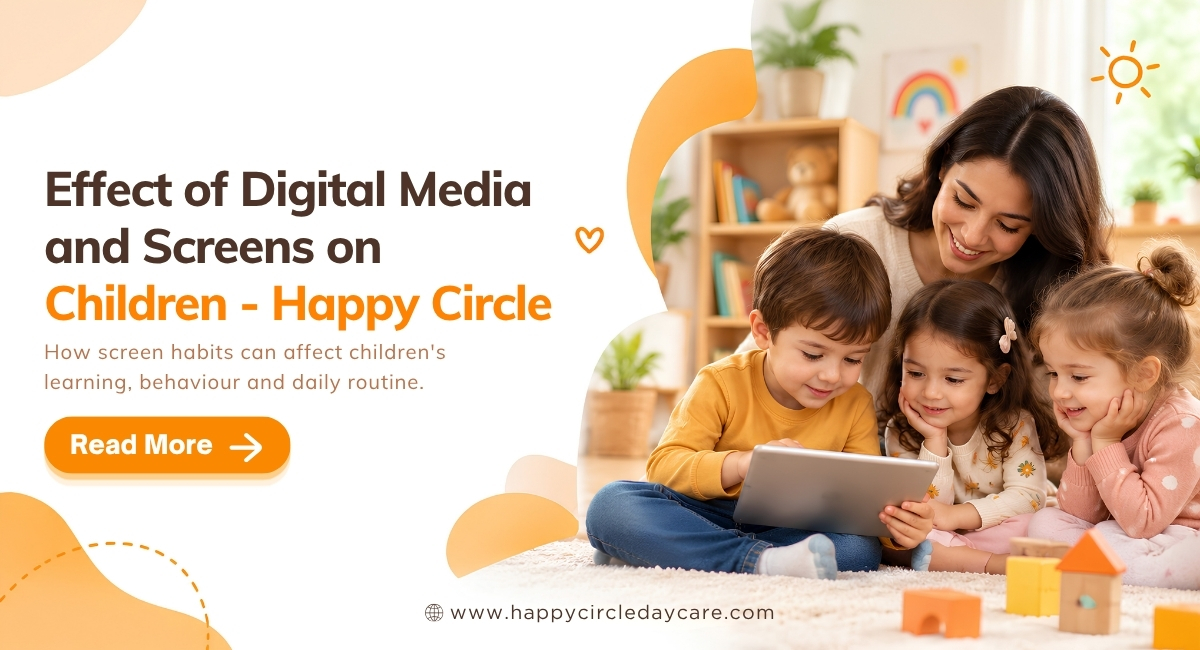
Table of content
- Introduction
- Screen Time Effects on Children: What Parents Should Understand
- Digital Media Impact on Kids: Sleep, Attention and Daily Life
- Screen Time for Preschoolers: What Can Get Crowded Out?
- Screen Time Guidelines for Toddlers and Preschoolers
- Healthy Screen Habits for Kids Start With the Family
- Screen Time Management for Parents Without Daily Arguments
- Screen-Free Activities for Preschoolers
- How Daycare in Indiranagar Can Support Real-World Learning
- Can Digital Media Ever Be Useful for Young Children?
- Conclusion
- Frequently Asked Questions
Introduction
Phones, televisions, tablets and digital videos are now part of everyday family life. For parents, the question is no longer simply whether children should use screens, but how much, what they should watch and what screen use may be replacing in their day. The screen time effects on children depend on age, content, timing and whether adults are involved. For toddlers and preschoolers especially, real conversations, movement, hands-on play, stories and interaction with caring adults remain extremely important for learning and development.
Screen Time Effects on Children: What Parents Should Understand
The biggest concern with screens is not simply that a child has looked at a phone or television. Problems are more likely when digital media begins taking the place of sleep, physical movement, conversation, reading, creative play and interaction with family members.
The American Academy of Pediatrics explains that heavy or poorly managed media use in early childhood can be linked with difficulties involving sleep, language, social skills, attention and emotional regulation. At the same time, the effect depends on the individual child, the type of content and how media is used. Its “5 C's” approach asks parents to consider the Child, Content, Calm, Crowding Out and Communication rather than looking only at minutes on a clock.
Digital Media Impact on Kids: Sleep, Attention and Daily Life
The digital media impact on kids can become more noticeable when screens are used for long periods or close to bedtime. A child who spends the evening moving quickly between videos may have less time for physical activity, books, conversation or the quiet transition needed before sleep.
The American Academy of Pediatrics notes that misuse of digital media in early childhood can be associated with unhealthy sleep and can reduce opportunities for reading, movement, exploration and interaction with caregivers. This does not mean one cartoon causes a developmental problem. Parents should look at the overall pattern across the child's day and week.
Another important factor is adult screen use. Young children learn through face-to-face communication, and frequent parent phone use during shared time can interrupt those interactions. Too much technology and too little conversation may affect opportunities for communication development.
Screen Time for Preschoolers: What Can Get Crowded Out?
When thinking about screen time for preschoolers, parents should ask a simple question: “What would my child be doing if the screen were not there?” A short educational programme may fit comfortably into the day. Several hours of videos, however, may replace outdoor play, drawing, building, pretend play or conversation.
This matters because preschool children learn strongly through real experiences. Running develops physical skills. Building with blocks involves problem-solving. Pretend play encourages imagination and communication. Talking with adults gives children opportunities to hear language and respond to it.
The American Academy of Pediatrics encourages families to protect time for play, reading and physical activity, while WHO guidance also stresses replacing prolonged sedentary screen use with active play and interactive activities such as storytelling.
Screen Time Guidelines for Toddlers and Preschoolers
Parents naturally want a clear answer about screen time guidelines for toddlers. The World Health Organization recommends no sedentary screen time for one-year-olds. For children aged two, sedentary screen time should be no more than one hour per day, with less being better. For children aged three to four, WHO also recommends no more than one hour per day.
American Academy of Pediatrics guidance also advises avoiding routine screen use for very young babies apart from video communication. If digital media is introduced between 18 and 24 months, parents are encouraged to choose high-quality content and watch with the child. For children aged two to five, longstanding AAP guidance recommends around one hour per day of high-quality content with adult involvement. Its newer guidance also asks families to consider content, the individual child and what media is replacing rather than treating time alone as the only measure.
Healthy Screen Habits for Kids Start With the Family
Building healthy screen habits for kids becomes easier when expectations apply to the household, not only to the child. If adults regularly scroll through phones during dinner while telling children that screens are not allowed, the rule can feel confusing.
Simple family habits can make a difference. Meals can remain focused on conversation. Phones can stay away during story time. Bedrooms can be quieter spaces, especially before sleep. Parents can also model putting a device away when someone is speaking.
It helps to set times and places where no screens are allowed, such as during meals and before bedtime. Children are also more likely to follow these habits when adults lead by example.
Screen Time Management for Parents Without Daily Arguments
Good screen time management for parents is often about making the ending predictable. If a child is allowed to watch videos without knowing when they will stop, suddenly taking away the device can easily lead to frustration.
Instead, create a clear pattern. A child might watch one selected programme after returning home, followed by play or dinner. Parents can explain the limit before the screen is turned on rather than introducing the rule only when it is time to stop.
Screens should also not become the only method used whenever a toddler feels bored, angry or upset. The AAP's guidance encourages parents to help young children learn different ways to calm themselves so that digital media does not become their main emotional coping tool.
Screen-Free Activities for Preschoolers
Useful screen-free activities for preschoolers do not have to be expensive or highly organised. Young children can spend meaningful time with blocks, crayons, picture books, puzzles, clay, music, pretend play, simple household tasks and outdoor movement.
The activity does not have to teach letters or numbers directly to be educational. Sorting toys involves thinking. Drawing encourages creativity and fine motor control. Listening to a story develops language. Running, climbing and dancing provide important physical experiences.
UNICEF India encourages families to talk, listen, sing, tell stories, play outdoors and limit digital media during interaction with young children. These simple experiences are especially relevant for families interested in early childhood development in Bangalore, where busy schedules can sometimes make handing a child a phone feel like the easiest option.
How Daycare in Indiranagar Can Support Real-World Learning
A quality daycare in Indiranagar can give children opportunities to spend part of their day interacting directly with people, materials and their environment. Group play, music, movement, storytelling, art and hands-on activities offer experiences that cannot be fully replaced by watching similar activities on a screen.
Happy Circle Child Care & Day Care offers a fun, play-based learning program that includes reading and language, music and movement, arts and crafts, emotional growth, science and math (STEM), and physical education. The center welcomes children from 1.6 to 12 years old in Indiranagar, Bangalore.
For parents comparing a child care centre in Bangalore, it is useful to ask how children spend their actual day. Find out how much time is available for physical movement, stories, creative activities, peer interaction and independent play rather than assuming that every “learning activity” needs digital technology.
Can Digital Media Ever Be Useful for Young Children?
Digital media is not automatically harmful. Content and context matter. High-quality educational programmes can introduce ideas, songs, stories and age-appropriate concepts, particularly when an adult watches with the child and talks about what they see.
The AAP notes that some well-designed educational programmes can support learning for toddlers and preschoolers. It recommends choosing suitable content, avoiding open access to phones or tablets and talking with children about what they watch.
Co-viewing can make media more interactive. A parent might watch a short programme about animals and later ask the child to identify similar animals in a book. The screen then becomes a small part of a wider learning experience rather than the entire experience itself.
Conclusion
Digital devices are part of modern life, so the goal does not need to be creating a childhood where a child never sees a screen. A healthier approach is to protect the experiences young children need most. Sleep, conversation, movement, play, stories and relationships should have enough space in every day. When parents understand the digital media impact on kids and create reasonable boundaries early, children can learn that screens are one activity among many rather than the centre of their free time.
Happy Circle Child Care & Day Care provides daycare in Indiranagar with a play-based curriculum that includes language, creative activities, movement, social interaction and early STEM experiences. Parents interested in creating a balanced, engaging environment for their child can visit the centre and understand how its programmes are organised. Explore Happy Circle Daycare Programs
Frequently Asked Questions
What can parents offer instead of a phone?
Books, drawing, blocks, puzzles, outdoor play, music, storytelling, pretend play and simple household activities can all keep young children engaged while supporting real-world interaction and learning.
Can using a screen before bed affect sleep?
Screen use close to bedtime can interfere with a calm bedtime routine, particularly when content is stimulating. The AAP recommends protecting bedtime from digital distractions and making bedrooms and the period before sleep more screen-free.
Should children use screens during meals?
Keeping meals screen-free can encourage conversation and help families pay more attention to eating and each other. The AAP recommends creating screen-free times and spaces as part of healthy family media habits.
Is educational screen time different from entertainment?
High-quality educational content can have value, especially when parents watch with children and connect what they see to real-world experiences. Simply labelling an app or video “educational” does not automatically make it suitable for a young child.
Is screen time harmful for preschoolers?
Not every use of a screen is harmful. The type of content, duration, timing and whether an adult is involved all matter. Problems are more likely when screen use becomes excessive or replaces important activities such as sleep, exercise, conversation and play.
How much screen time should a two-year-old have?
WHO recommends that sedentary screen time for two-year-olds should be no more than one hour per day, with less being better. Parents should also protect time for physical activity, sleep, reading and interaction.
What are the main screen time effects on children?
The effects depend on age, content, duration and context. Heavy or poorly managed screen use can crowd out sleep, movement, reading, conversation and play. These activities are particularly important during early childhood.

Happy Circle Child Care & Day Care
Happy Circle Day Care