Fun Counting and Number Activities for Preschool Kids
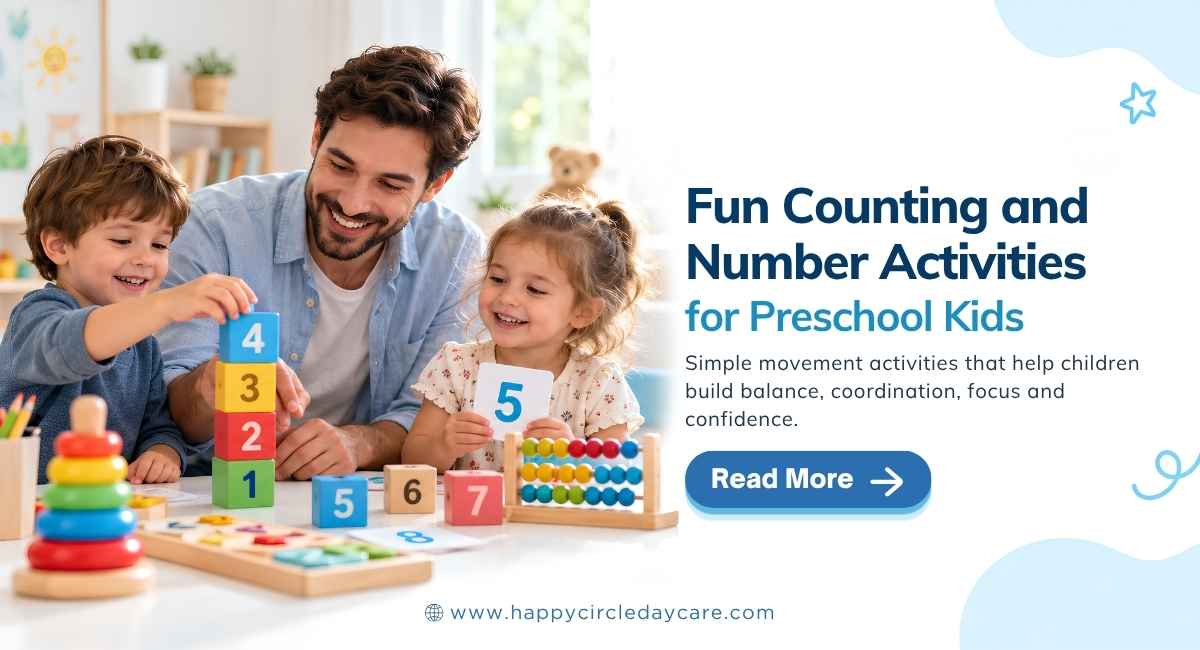
Table of content
1. Introduction
2. Why Counting and Number Activities Matter for Preschoolers
3. Counting Everyday Objects Around the House
4. Learning Numbers Through Songs and Rhymes
5. Sorting and Matching Games for Early Maths
6. Number Treasure Hunts and Outdoor Counting Games
7. Learning Shapes, Patterns and Simple Measurements
8. Fun Number Games for Children Aged 3 to 5
9. How Parents and Daycare Teachers Can Support Early Maths
10.Conclusion
11.Frequently Asked Questions
Introduction
Have you ever noticed your child counting their toys, pointing at numbers on a lift or asking for two more biscuits? These small moments show how children begin learning maths through everyday experiences. They may not understand addition or subtraction yet, but they are already exploring numbers, shapes and quantities.
For parents looking for counting activities for preschoolers, learning does not have to involve worksheets or long lessons. Simple games using toys, blocks, songs and household objects can make numbers interesting and easy to understand. Children between three and five years old are naturally curious. They enjoy touching, moving, sorting and exploring things around them. When parents and teachers use this curiosity to introduce basic maths, children can gradually develop confidence and important thinking skills while having fun.
1. Why Counting and Number Activities Matter for Preschoolers
Early maths learning is about much more than remembering numbers from one to ten. Children also learn to recognise quantities, compare objects, identify shapes and understand simple patterns. These skills become useful when they start learning addition, subtraction and other mathematical concepts in school. For example, when a child shares four biscuits equally with a friend, they begin understanding how quantities work. Similarly, arranging toys from smallest to biggest introduces comparison and order.
Learning Through Everyday Experiences: Young children understand ideas better when they can see and touch objects. Play based maths learning allows them to explore numbers naturally instead of depending only on written exercises. According to UNICEF Parenting, playful learning experiences support children's early development. Parents should remember that children learn at different speeds. Some recognise numbers quickly, while others need more time and practice. The goal is to make maths familiar and enjoyable.
2. Counting Everyday Objects Around the House
One of the easiest ways to introduce numbers is by using objects children already know. You do not need expensive learning materials or special equipment. Toys, spoons, crayons and building blocks can become useful counting tools.
Counting Toys and Household Items: Ask your child to place five toy cars in a row and count them slowly. You can also encourage them to count plates while setting the dining table or xaczk fta apples in a basket. These simple number activities help children connect spoken numbers to actual quantities. At first, children may repeat number names without understanding what they represent. Parents can help by encouraging them to touch or move one object each time they say a number. This helps them understand that each object is counted once. Keep activities short and enjoyable so children remain interested.
3. Learning Numbers Through Songs and Rhymes
Preschool children enjoy music, movement and repetition. Counting songs can introduce numbers in a way that feels natural and entertaining. Rhymes such as "Five Little Ducks" and "One, Two, Buckle My Shoe" allow children to hear numbers repeatedly.
Adding Actions to Counting Songs: Parents can encourage children to show numbers using their fingers while singing. For example, during a song about five ducks, children can raise five fingers and lower one as each duck disappears. This introduces the idea of taking away objects without requiring written calculations. Teachers can also include clapping, jumping and simple dance movements. These activities support listening, movement and number recognition. Children may enjoy repeating the same song several times, and this repetition can help them remember number sequences. There is no need to correct every mistake immediately. Gentle encouragement makes learning more comfortable.
4. Sorting and Matching Games for Early Maths
Sorting is an important early maths skill because it teaches children to notice similarities and differences. Preschoolers can begin by grouping objects according to colour, shape or size. For example, ask your child to place red blocks in one basket and blue blocks in another. Once they understand the activity, introduce more challenging tasks.
Matching Colours, Shapes and Numbers: Children can match number cards with groups of objects. A card showing the number three can be placed beside three toy animals. They can also arrange objects from shortest to tallest or smallest to largest. These early maths activities for preschoolers encourage observation, comparison and logical thinking. The NAEYC provides resources explaining how young children develop mathematical understanding through meaningful activities. Parents can make sorting games more interesting by using safe household objects such as large blocks, clothes or picture cards. Avoid small objects that may create choking risks for younger children.
5. Number Treasure Hunts and Outdoor Counting Games
Children often enjoy learning when they can move around and explore their surroundings. A number treasure hunt can turn an ordinary afternoon into a fun learning experience. Parents can place number cards around a room and ask children to find them. For example, when a child finds the number four, they can collect four large building blocks.
Counting During Outdoor Play: Outdoor activities also provide opportunities to practise counting. Children can count steps while walking, identify numbers on doors or count the swings at a playground. They may also enjoy collecting fallen leaves and arranging them into groups. These experiences show children that numbers are useful outside books and classrooms. Outdoor counting games can support movement, observation and curiosity. Parents should supervise activities and choose safe objects and play areas. The focus should remain on exploration rather than completing every task correctly.
6. Learning Shapes, Patterns and Simple Measurements
Early maths includes understanding shapes, patterns and sizes. Children often notice circles, squares and triangles in everyday objects before learning their names. A clock may look like a circle, while a window may resemble a rectangle. Parents can encourage children to identify these shapes during daily activities.
Introducing Patterns Through Play: Patterns help children understand how objects follow a particular order. For example, arrange blocks in a red, blue, red, blue sequence and ask your child which colour comes next. Children can also create patterns using large beads, picture cards or coloured paper. Simple measurement activities can be introduced by comparing two objects. Ask which pencil is longer or which container holds more water. These experiences encourage children to observe, compare and think carefully. They also prepare children for more detailed mathematical learning in later years.
7. Fun Number Games for Children Aged 3 to 5
Children between three and five years old have different learning abilities. A three-year-old may enjoy counting objects with help, while a five-year-old may be ready to compare quantities or explore simple addition. Activities should match the child's interest and understanding.
Easy Games for Different Age Groups: For three-year-olds, begin with counting fingers, matching shapes and identifying small groups of objects. Four-year-olds may enjoy number puzzles, sorting games and counting steps. Five-year-olds can explore simple addition using toys or picture cards. These number games for 3 to 5 year old children should be introduced gradually. If a child finds an activity difficult, simplify it rather than expecting immediate improvement. Parents can also allow children to choose their favourite games. When children enjoy the activity, they are more likely to participate willingly.
8. How Parents and Daycare Teachers Can Support Early Maths
Parents and teachers play an important role in helping children feel comfortable with numbers. Young children benefit from patient explanations, regular encouragement and opportunities to explore independently. Rather than asking children to memorise answers, adults can encourage them to think about what they are doing. For example, instead of immediately telling a child how many blocks are on the table, ask them to count and check.
Creating a Positive Learning Environment: A comfortable learning environment gives children the freedom to ask questions and make mistakes. Teachers can include counting games, storytelling, building blocks and sorting activities in daily routines. These preschool learning activities help children practise maths without making it feel like a formal lesson. The American Academy of Pediatrics highlights the importance of play in children's learning and development. Parents exploring daycare activities in Indiranagar can look for centres that balance guided learning with free play.
Conclusion: Making Early Maths a Happy Learning Experience
Children start learning about numbers through simple things they do every day, like counting toys, sharing snacks or arranging blocks. Parents can make learning fun by playing small counting games, asking simple questions and encouraging children to try new activities. There is no need to rush or expect perfect answers. Every child learns at their own pace, and even small improvements are worth celebrating. When children enjoy learning numbers through play, maths becomes something they look forward to rather than something they find difficult.
At Happy Circle Childcare & Daycare, we believe every child deserves a safe, loving and happy place to learn and grow. Our caring team, fun-filled activities and age-appropriate learning programmes help children build confidence, make friends and develop healthy habits. If you're looking for a nurturing environment for your little one, explore our Daycare Admissions to learn more about our programmes. Give your child a wonderful start to their early years and Enrol Now at Happy Circle Childcare & Daycare!
Frequently Asked Questions
How much time should preschoolers spend on maths activities?
Short, enjoyable activities are usually suitable for preschoolers. Parents can include counting naturally during meals, playtime and daily routines without setting strict study hours.
Can children learn maths without worksheets?
Yes. Young children can develop early maths skills through games, building blocks, storytelling, sorting and everyday activities. Worksheets are not necessary for every learning experience.
How can I teach my three-year-old to count at home?
Start with a few familiar objects, such as toys or fruits. Count them slowly together and encourage your child to touch each object while saying the number.
At what age should children start learning numbers?
Children can begin exploring numbers during their toddler years through songs, play and everyday conversations. More structured activities can be introduced gradually as they grow.
What are the best counting activities for preschoolers?
Counting toys, singing number rhymes, sorting blocks and playing number-matching games are simple activities that help preschoolers become familiar with numbers.

Happy Circle Child Care & Day Care
Happy Circle Day Care